How to Calculate GPA in College: The Complete Guide (With Examples)
How to Calculate GPA in 30 Seconds
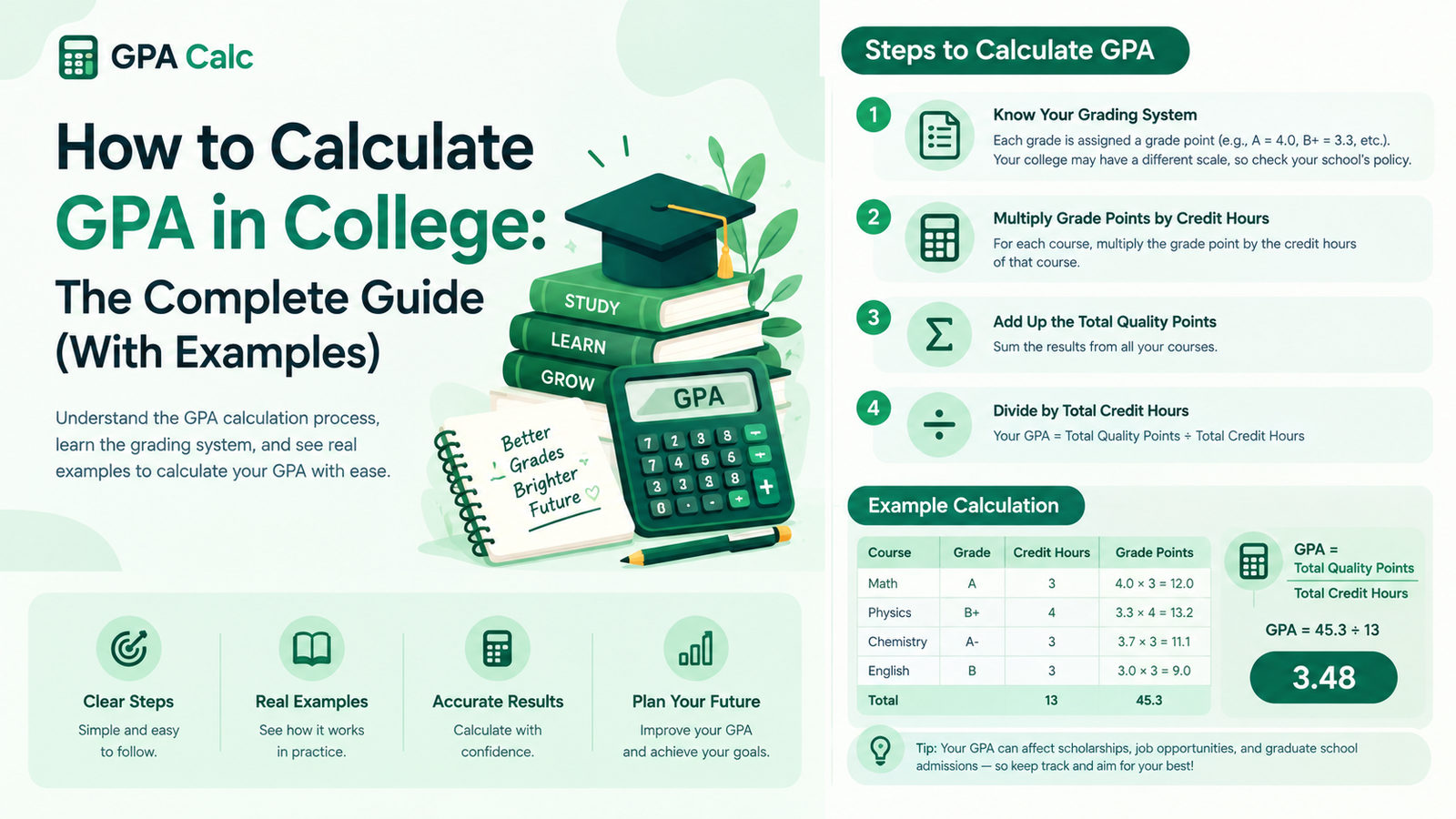
GPA = Total Quality Points ÷ Total Credit Hours. Convert each letter grade to its 4.0-scale point value, multiply by the course’s credit hours, add everything up, and divide by total credits. Example: 37.9 quality points ÷ 11 credits = 3.45 GPA. The full step-by-step with tables is below.
What Is GPA?
GPA (Grade Point Average) is the standard US measure of academic performance — a single number, usually on a 4.0 scale, that summarizes all your course grades weighted by credit hours. Colleges use it for admissions, scholarships, honors, and graduation eligibility. Most US schools require a minimum 2.0 cumulative GPA to graduate; honors typically start at 3.5.
The Standard 4.0 GPA Scale
Convert each letter grade using this table (the scale used by most US colleges):
| Letter Grade | Point Value |
|---|---|
| A+ / A | 4.0 |
| A− | 3.7 |
| B+ | 3.3 |
| B | 3.0 |
| B− | 2.7 |
| C+ | 2.3 |
| C | 2.0 |
| C− | 1.7 |
| D+ | 1.3 |
| D | 1.0 |
| F | 0.0 |
Note: some schools use slight variations (e.g., A+ = 4.3). Always check your institution’s scale for official records.
How to Calculate GPA: Step by Step
Step 1 — Convert each grade to grade points
Look up every course’s letter grade on the 4.0 scale above.
Step 2 — Multiply by credit hours (quality points)
Quality points = grade point value × credit hours. A 3-credit A is worth 12.0 quality points; a 4-credit B+ is worth 13.2.
Step 3 — Add up quality points and credit hours
Sum both columns separately across all courses.
Step 4 — Divide
GPA = Total Quality Points ÷ Total Credit Hours. Round to two decimals — that’s the number on your transcript.
Worked Example
| Course | Grade | Credits | Points | Quality Points |
|---|---|---|---|---|
| English 101 | A | 3 | 4.0 | 12.0 |
| Calculus I | B+ | 4 | 3.3 | 13.2 |
| US History | B | 3 | 3.0 | 9.0 |
| Biology Lab | A− | 1 | 3.7 | 3.7 |
| Total | 11 | 37.9 |
GPA = 37.9 ÷ 11 = 3.45. Notice how the 4-credit Calculus course pulls more weight than the 1-credit lab — credit hours decide each grade’s influence.
Semester GPA vs. Cumulative GPA
Semester GPA covers one term only (the calculation above). Cumulative GPA uses the same formula but across every semester: add all quality points you’ve ever earned and divide by all credit hours attempted. Your cumulative GPA is the number on your diploma, transcript, and job applications.
Weighted vs. Unweighted GPA
Unweighted GPA uses the plain 4.0 scale — an A is 4.0 whether the class was regular or AP. Weighted GPA gives bonus points for harder courses (often AP = +1.0, honors = +0.5), so GPAs can exceed 4.0 — that’s why you see “4.6 GPA” on college applications. Colleges usually recalculate to unweighted for fair comparison.
What Grades Don’t Count
Withdrawals (W), incompletes (I), pass/fail (P/F or S/U), and audit grades are excluded from GPA math — don’t include their credits in your totals. A failed course (F), however, counts as 0.0 points and its credits still count, which is why an F hurts far more than a W.
Frequently Asked Questions
What is a good GPA in college?
A 3.0 is the widely used cutoff for “good” — it keeps you eligible for most internships and graduate programs. 3.5+ opens honors and competitive scholarships; 3.7+ is competitive for top graduate schools.
How much does one C affect my GPA?
It depends on credit hours. Replacing a 3-credit B (9.0 points) with a C (6.0 points) costs 3 quality points — on a 15-credit semester that’s a 0.20 GPA drop. Heavy courses amplify every grade.
Is a 3.45 GPA good?
Yes — 3.45 sits comfortably above the 3.0 benchmark most employers and programs use, and within range of cum laude honors (typically 3.5) at many schools.
Can I raise my GPA after a bad semester?
Yes, but math sets the pace: GPA is cumulative, so each new semester dilutes old grades. Earning straight As in a 15-credit term after a 2.5 semester typically lifts you ~0.3–0.5 points, depending on total credits banked.
Do colleges look at weighted or unweighted GPA?
Most recalculate to unweighted 4.0 for comparison, then consider course rigor separately. Report whichever your school puts on the transcript, and note the scale.
Try it: use our free GPA calculator to compute your semester or cumulative GPA instantly — no sign-up needed.