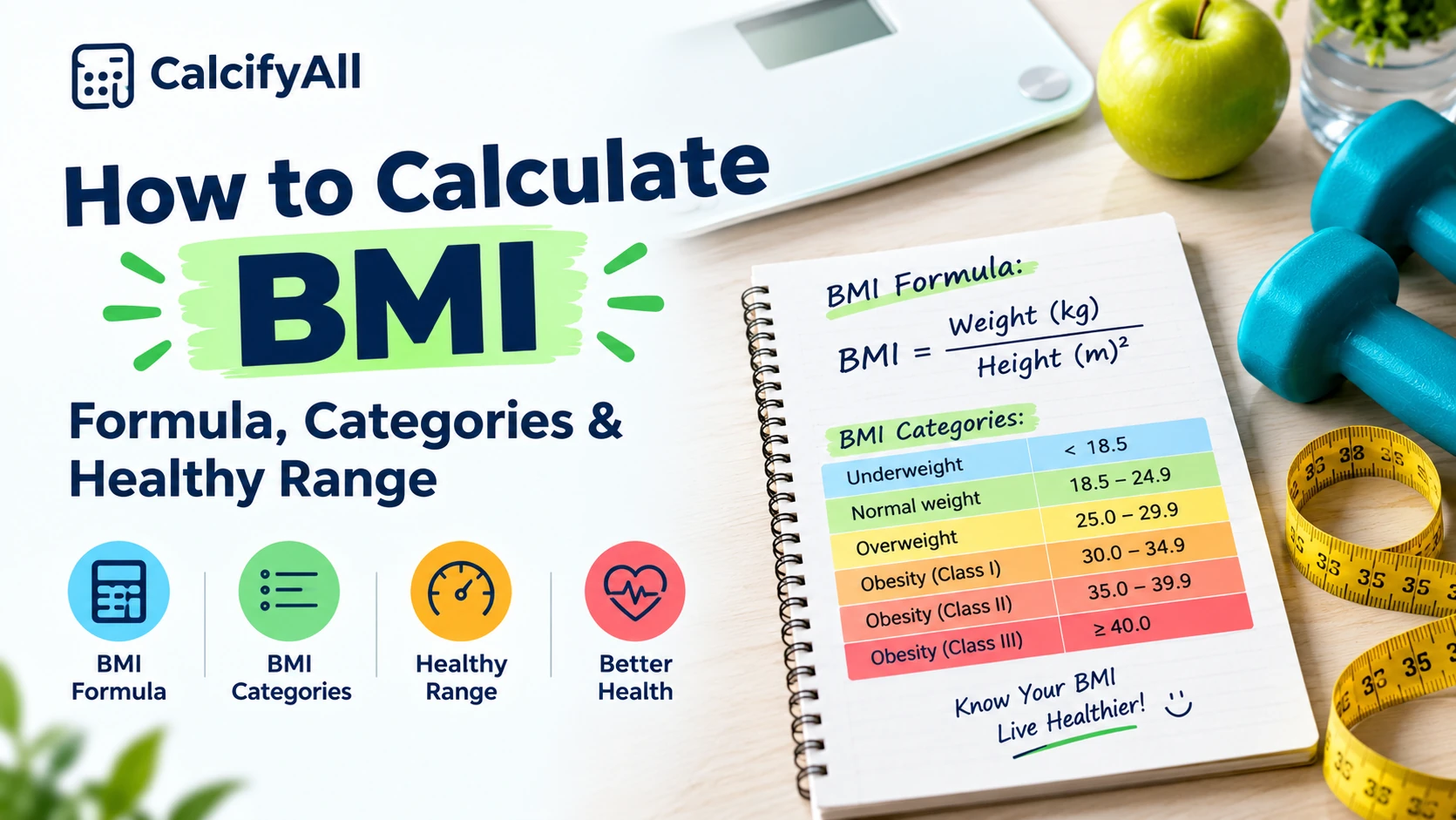
Body Mass Index (BMI) is your weight divided by the square of your height. In metric units, BMI = weight in kilograms ÷ (height in metres)². In US customary units, BMI = 703 × weight in pounds ÷ (height in inches)². A BMI of 18.5 to 24.9 is classified as the healthy (normal) range by the US Centers for Disease Control and Prevention (CDC). This guide shows both formulas, works through two verified examples, explains the CDC categories, and covers what BMI gets wrong — so you can interpret your number honestly.
If you want the answer without doing the arithmetic yourself, use the free BMI calculator — enter your height and weight and it computes your BMI and category instantly.
What Is the Formula for BMI?
BMI was designed as a quick screening number, not a direct measurement of body fat. It uses only two inputs — height and weight — which is why it is so widely used and also why it has well-known limits (covered below).
Metric formula: BMI = kg ÷ m². Divide your weight in kilograms by your height in metres squared.
Imperial formula: BMI = 703 × lb ÷ in². Multiply your weight in pounds by 703, then divide by your height in inches squared. The 703 is a conversion factor that makes the imperial result match the metric scale.
Both formulas give the same scale, so a person gets (within rounding) the same BMI either way. If your height is in feet and inches, convert it first: 5 feet 9 inches is 69 inches, or 1.75 metres.
How Do You Calculate BMI? Step-by-Step
Worked example 1 (metric). A person weighs 70 kg and is 1.75 m tall.
- Square the height: 1.75 × 1.75 = 3.0625.
- Divide the weight by that number: 70 ÷ 3.0625 = 22.857.
- Round to one decimal place: BMI = 22.9.
22.9 falls in the 18.5–24.9 range, so this is classified as a healthy (normal) BMI.
Worked example 2 (imperial). A person weighs 154 lb and is 5 feet 9 inches (69 inches) tall.
- Multiply weight by 703: 154 × 703 = 108,262.
- Square the height: 69 × 69 = 4,761.
- Divide: 108,262 ÷ 4,761 = 22.739.
- Round to one decimal place: BMI = 22.7.
Note that 154 lb is 69.9 kg and 69 inches is 1.75 m, so examples 1 and 2 describe essentially the same person — and the two formulas agree (22.9 vs 22.7, the small gap coming from rounding the weight conversion).
Worked example 3 (a higher result). A person weighs 180 lb and is 5 feet 10 inches (70 inches) tall: 703 × 180 = 126,540; 70 × 70 = 4,900; 126,540 ÷ 4,900 = 25.824, so BMI = 25.8. That falls just into the overweight category — a useful reminder that a few pounds either side of a boundary change the label, even though the health picture barely changes.
What Are the BMI Categories?
The CDC adult BMI categories are the standard used in the United States. They apply to adults aged 20 and over; children and teens use age-and-sex-specific BMI percentiles instead, which this guide does not cover.
| BMI range | Category |
|---|---|
| Below 18.5 | Underweight |
| 18.5 – 24.9 | Healthy (normal) weight |
| 25.0 – 29.9 | Overweight |
| 30.0 and above | Obese |
Obesity is sometimes split further: class I is 30.0–34.9, class II is 35.0–39.9, and class III (sometimes called severe obesity) is 40.0 and above. These cut-offs are screening thresholds, not diagnoses — a doctor looks at the whole picture, not the number alone.
What Is a Healthy BMI?
On paper, a healthy BMI is 18.5 to 24.9. In practice, health risk rises gradually as BMI moves away from that range in either direction; there is no cliff edge at 25.0. Large population studies associate the lowest mortality risk with a BMI roughly in the low-to-mid 20s, but individual risk also depends on where fat is carried (waist circumference matters), fitness level, diet, smoking, and family history.
Two practical points follow. First, if your BMI is 25.8 like example 3, the sensible response is a modest, sustainable change — not alarm. Second, if your BMI is below 18.5, that also deserves attention: being underweight can signal inadequate nutrition or an underlying health issue, and it carries its own risks.
What Are the Limitations of BMI?
BMI is a screening tool, and it misleads in predictable cases:
- Athletes and muscular builds. Muscle is denser than fat, so a muscular person can have a BMI over 25 — even over 30 — while carrying little body fat. BMI cannot tell muscle from fat.
- Age. Older adults naturally lose muscle and gain fat at the same weight, so the same BMI can hide more body fat at 70 than at 30.
- Sex and body composition. At the same BMI, women typically carry a higher body-fat percentage than men, because BMI ignores composition entirely.
- Fat distribution. Belly (abdominal) fat carries more health risk than fat on the hips and thighs, but BMI treats all weight the same. Waist circumference is a useful second check: above about 40 inches (102 cm) for men and 35 inches (88 cm) for women signals higher risk.
- Height extremes and pregnancy. BMI is less reliable at very short or tall heights, and it is not used during pregnancy.
None of this makes BMI useless — it is free, instant, and right for most people most of the time. It means you should treat it as a first screen, not a final verdict.
BMI vs Body Fat Percentage: What Is the Difference?
BMI estimates weight relative to height. Body fat percentage measures what fraction of your weight is actually fat. They answer different questions, and body fat percentage is the more direct health measure — but it is harder to get right, needing calipers, a smart scale, a DEXA scan, or a circumference-based estimate.
As a rough guide, a healthy body-fat range is about 10–20% for men and 18–28% for women, with athletes lower and older adults higher. If your BMI says overweight but you train hard and carry visible muscle, a body-fat estimate will usually clear up the contradiction. CalcifyAll also has a body fat calculator if you want that second number.
How Can You Use Your BMI Result?
Use it as a starting point: calculate it, check the category, then add context — waist measurement, activity level, and how the number is trending over months rather than days. If your BMI is outside the healthy range and stays there, that is a reasonable prompt to talk to a clinician, especially if you have other risk factors such as high blood pressure or a family history of diabetes.
One last habit makes the number more useful: track it the same way each time — same scale, similar time of day, similar clothing — and look at the trend over months rather than reacting to a single reading. Weight naturally fluctuates a kilogram or two day to day from water, food, and clothing, so a single weigh-in never tells the whole story. A steady trend in the right direction matters far more than any one day’s figure.
Try it now with the free BMI calculator: enter your height and weight, and it returns your BMI and category with no sign-up.
Frequently Asked Questions
What is the formula for calculating BMI?
BMI = weight in kilograms divided by height in metres squared (kg/m²). In imperial units, BMI = 703 × weight in pounds divided by height in inches squared. For example, 70 kg at 1.75 m gives 70 ÷ 3.0625 = 22.9.
What is considered a healthy BMI?
According to the CDC, a healthy (normal) BMI for adults is 18.5 to 24.9. Below 18.5 is underweight, 25.0–29.9 is overweight, and 30.0 or above is obese. Risk rises gradually outside the healthy range rather than jumping at a single cut-off.
How do I calculate BMI in pounds and inches?
Multiply your weight in pounds by 703, then divide by your height in inches squared. Example: 154 lb at 69 inches gives 703 × 154 ÷ 4,761 = 22.7.
Is BMI accurate?
BMI is accurate as a population screening tool but imperfect for individuals: it cannot distinguish muscle from fat, so athletes can score as overweight, and it ignores fat distribution and age-related muscle loss. Pair it with waist circumference or a body-fat estimate for a fuller picture.
What is the difference between BMI and body fat percentage?
BMI compares your total weight to your height; body fat percentage measures how much of that weight is fat. Body fat percentage is the more direct health measure but requires calipers, a smart scale, or a scan to estimate well, while BMI needs only height and weight.
Does BMI differ for men and women, or by age?
The adult BMI categories are the same for men and women, but at the same BMI women typically have a higher body-fat percentage. BMI also becomes less informative with age, because muscle loss means the same BMI can hide more fat in an older adult. Children and teens use separate age-and-sex BMI percentiles, not the adult categories.